AI
Partnership
News
As companies grow, they often invest in more tools, more systems, and more processes. New software gets added. Teams expand. More meetings are scheduled. More reports are created.
At first, this feels like progress.
But over time, something unexpected happens.
Information becomes fragmented.
Customer data lives in one platform. Team discussions happen in another. Coaching insights stay inside meetings. Strategic decisions are documented somewhere else. Valuable knowledge becomes scattered across spreadsheets, Slack threads, CRM systems, dashboards, and documents.
The result is a challenge many growing businesses face: plenty of information, but limited visibility.
When More Information Creates Less Clarity
Most business leaders don't struggle because they lack data. They struggle because they have too much of it spread across too many places.
Questions that should be easy to answer become surprisingly difficult:
- What are the biggest obstacles slowing down the sales team?
- Which coaching conversations are actually driving performance improvements?
- Are departments aligned around the same priorities?
- What patterns are emerging across the business?
- Which opportunities are being missed because information isn't connected?
When answers require searching through multiple tools and conversations, valuable time gets lost. Even worse, important insights can disappear entirely.
The Real Cost of Information Silos
Information silos affect more than productivity. They impact decision-making.
Leadership teams often make decisions based on incomplete information because the full picture isn't visible in one place.
A sales manager may have access to CRM reports but not coaching insights.
A leadership coach may understand team challenges but lack access to operational data.
Executives may review performance dashboards without understanding the conversations happening behind the numbers.
The problem isn't that the information doesn't exist.
The problem is that it isn't connected.
A Different Approach to Organizational Intelligence
This challenge was one of the driving ideas behind Excello OS.
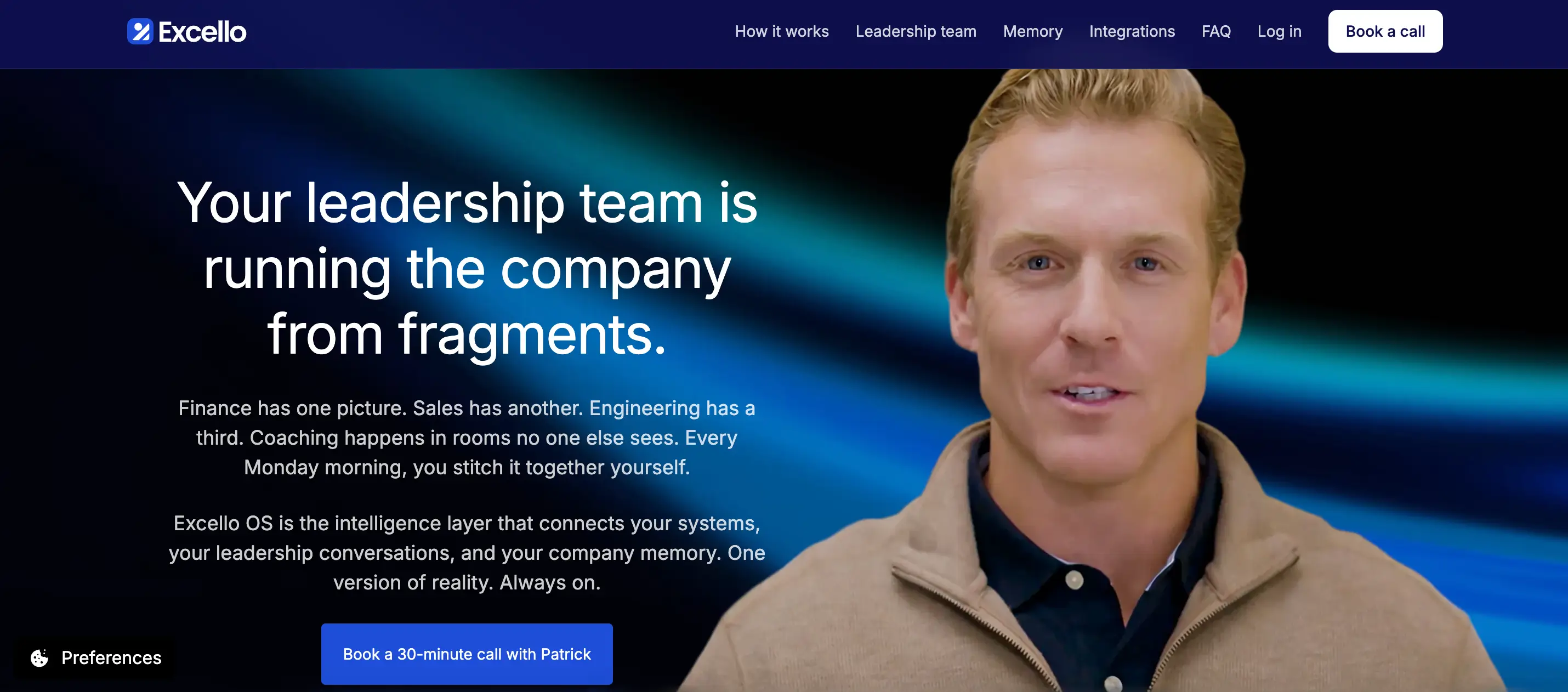
While working on the Excello OS project, I had the opportunity to explore how growing organizations can bring together information that would otherwise remain fragmented across systems, departments, and conversations.
Rather than creating another reporting tool, the goal was to build a platform that helps leadership teams gain a clearer understanding of what is happening across the business.
The concept is simple.
Instead of treating meetings, coaching conversations, sales activities, and operational data as separate pieces, connect them into a single source of organizational intelligence.
This allows leaders to identify patterns, uncover blind spots, and make more informed decisions.

Helping Leadership Teams See the Bigger Picture
One of the most interesting aspects of Excello OS is its focus on leadership visibility.
Many organizations have no shortage of reports.
What they often lack is context.
Numbers can tell you what happened.
Conversations often explain why.
When those two elements remain disconnected, leaders are left making decisions without a complete understanding of the situation.
Excello OS helps bridge that gap by bringing together information from multiple sources and transforming it into actionable insights.
Instead of jumping between systems, leadership teams can gain a more unified view of the organization.
Sales Intelligence Beyond Traditional Reporting
Sales teams generate enormous amounts of data.
Activities are tracked. Opportunities are monitored. Forecasts are updated.
Yet performance challenges can still be difficult to identify.
Traditional reporting often focuses on outcomes.
Organizational intelligence focuses on understanding the factors that create those outcomes.
By connecting data with coaching insights and operational context, leaders can move beyond surface-level reporting and identify opportunities for improvement before they become larger problems.
Turning Coaching Into Organizational Knowledge
Many companies invest heavily in leadership coaching and professional development.
The challenge is that valuable lessons often remain isolated within individual sessions.
A breakthrough conversation may help one manager improve performance, but the insight rarely becomes part of the organization's shared knowledge.
Over time, companies lose access to lessons that could benefit entire teams.
Excello OS approaches this challenge differently.
By creating a structured system for capturing and connecting insights, organizations can transform individual coaching moments into valuable institutional knowledge.
This helps create continuity, improve alignment, and reduce the risk of important information being lost.
Building Organizational Memory
One of the most overlooked challenges in growing companies is organizational memory.
Employees change roles. Teams expand. Processes evolve.
Without a reliable system for preserving knowledge, organizations often find themselves repeating the same conversations and solving the same problems multiple times.
An effective organizational memory helps companies retain context, learn from previous decisions, and maintain consistency as they scale.
This is particularly important for leadership teams responsible for navigating growth while keeping everyone aligned.

Why Simplicity Matters in Complex Products
Platforms like Excello OS deal with a significant amount of complexity behind the scenes.
Multiple systems must work together. Large amounts of information need to be processed.
Advanced technology powers the experience. Yet none of that matters if users can't quickly understand the value being offered.
One of the biggest challenges in designing technology products is balancing sophistication with simplicity.
The most powerful solution isn't always the one with the most features.
It's the one people can actually understand and use effectively.
Designing Excello OS: Making Complexity Feel Clear
While working on Excello OS, my focus wasn't simply on creating a visually appealing website.
The challenge was translating a sophisticated platform into an experience that felt approachable, trustworthy, and easy to understand.
Visitors arriving on the website needed to quickly understand:
- The problem Excello OS solves
- Who the platform is built for
- How it creates value
- Why leadership teams should care
Rather than overwhelming visitors with technical language, the experience focuses on business outcomes and practical benefits.
Each section was designed to guide visitors through the story step by step, helping them understand how disconnected information impacts business performance and how a unified system can improve visibility and decision-making.
Projects like this are a reminder that good UI/UX design is often less about visuals and more about helping people understand what to do next.
What Businesses Can Learn From Excello OS
The challenges Excello OS addresses aren't unique to large enterprises.
Many growing businesses experience similar issues.
- Information becomes fragmented.
- Knowledge becomes difficult to access.
- Teams lose visibility.
- Decision-making becomes slower.
Whether through technology, process improvements, or better communication systems, organizations that connect information effectively gain a significant advantage.
The goal isn't simply collecting more data. The goal is creating clarity.
Because when leaders can clearly see what's happening across their organization, they can make better decisions, support their teams more effectively, and create stronger long-term results.

Final Thoughts
Growth creates complexity.
More people, more systems, and more information inevitably make organizations harder to manage.
The challenge isn't avoiding complexity altogether.
It's preventing that complexity from becoming fragmentation.
Excello OS demonstrates how technology can help organizations connect information, preserve knowledge, and create greater visibility across teams.
And from a design perspective, projects like this highlight the importance of transforming sophisticated ideas into experiences that feel clear, approachable, and actionable.
When information becomes connected, businesses gain something far more valuable than data.
They gain understanding.
About the Author:

As a blog author at Mykola Designer, I explain how global teams can build high-converting and trust-building websites. In my articles, I combine strategic UI/UX design with expert marketing and no-code development and provide full-scale landing pages, brand identity systems, and SEO/GEO optimization for startups looking to turn concepts into scalable products.
Let’s connect on LinkedIn or X to build awesome projects together.
Share this article: