Web Design
Partnership
The website that helps a SaaS startup launch is rarely the same website it needs two years later.
Your product evolves, your audience expands, and your marketing team needs more than a homepage that explains what you do. You need a website that supports new features, speaks to different buyers, and makes it easier to launch campaigns without rebuilding everything from scratch.
The challenge isn't always finding someone who can redesign it. It's finding someone who understands what needs to change, what should stay, and how today's decisions will affect the next stage of growth.
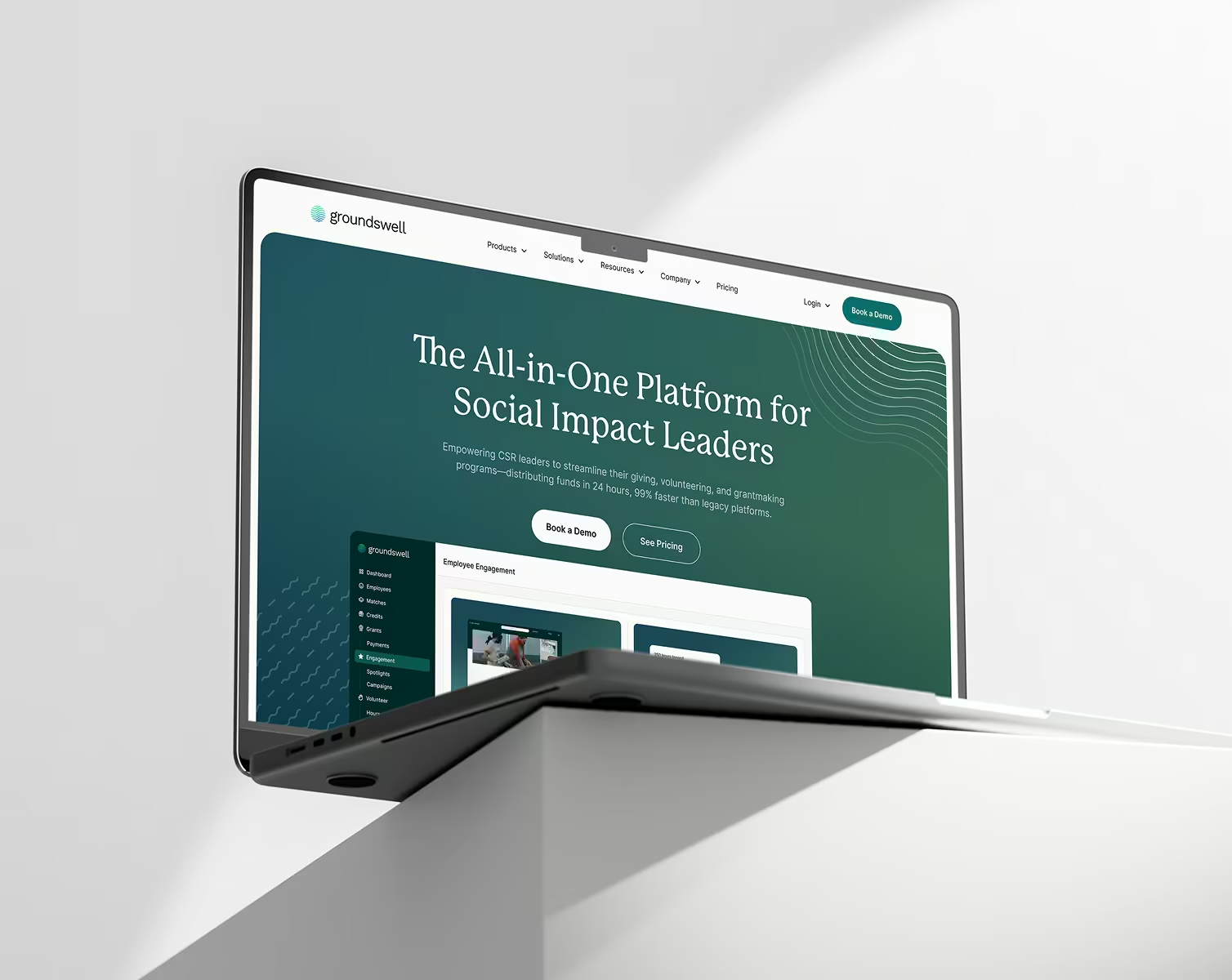
That's something I experienced firsthand during my SaaS website design partnership with Groundswell, a corporate social impact software company.
What started with five hours of design work per week developed into a collaboration lasting over two and a half years. During that time, my responsibilities evolved from building the website's foundation to leading web design and eventually advising on UX, web strategy, and funnel optimization.
Looking back, the most interesting part isn't how different the website looks today. It's how much the work changed as the company grew.
Starting With the MVP: Making the Product Easy to Understand
Before a SaaS company can convince visitors to request a demo, it needs to communicate what the product actually does.
For Groundswell, that meant introducing a platform that brings employee giving, volunteering, grantmaking, and corporate philanthropy into one place.
The software helps organizations manage social impact programs, from employee participation and donation processing to administration and reporting.
When I joined the project in February 2024, Groundswell was still developing its website presence. The initial scope was modest, with around five hours of design work each week.
Our first priority was establishing a clear website experience around the product.
At that stage, we weren't trying to build every page the company might eventually need. The focus was on creating a useful starting point with a visual direction that could support future development.
As Groundswell's offering and marketing needs expanded, the website had to communicate more than the basics.
Someone researching employee volunteering software might be interested in a different set of capabilities than a company evaluating grant management. Enterprise buyers also need enough detail to assess whether a platform fits their organization's requirements.
Those differences became increasingly important as we developed the website.
A Custom Brand That Still Feels Familiar to SaaS Buyers
A SaaS website needs to be recognizable, but it also needs to be easy to use.
There's nothing wrong with familiar elements such as product screenshots, prominent demo buttons, or clear navigation. Visitors already understand how these patterns work.
The challenge is creating a visual identity that feels specific to the company rather than relying on a generic template.
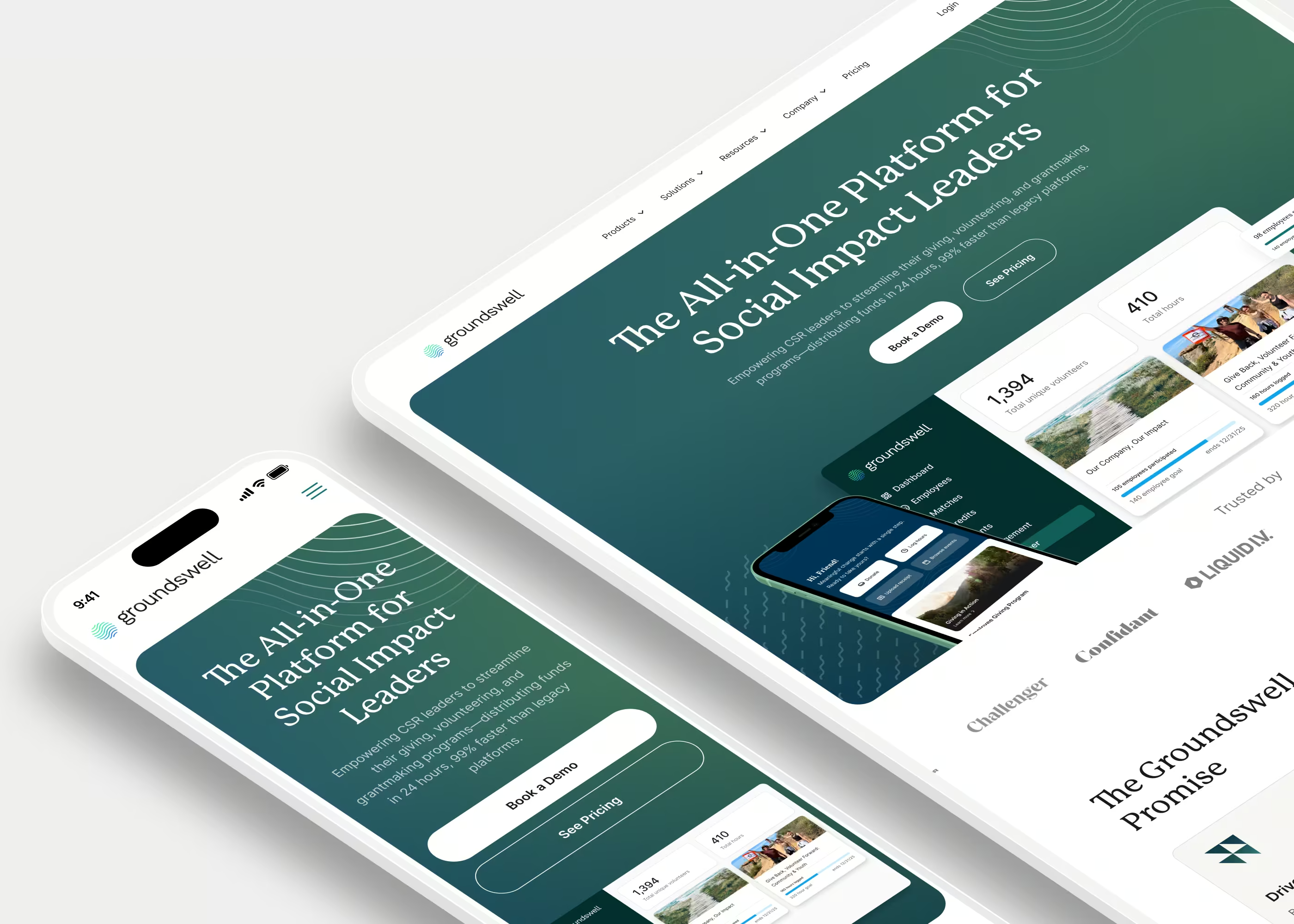
For Groundswell, I worked with its brand direction to create a cohesive website experience using typography, color, illustrations, product imagery, and consistent interface elements.
The design needed to feel approachable, reflecting the company's social impact focus, while remaining credible for enterprise customers.
That balance mattered across different pages. A product overview might introduce the platform at a high level, while a solution page needs room for more detailed information.
Instead of forcing every page into one layout, we used a consistent visual language that could accommodate different content.
The same brand direction also extended beyond the website into social media and other marketing applications.
For SaaS brand design, that's an important distinction: consistency doesn't mean repeating the same composition everywhere. It means customers can recognize your company wherever they encounter it.
Scaling the Website Without Starting From Scratch
As Groundswell expanded, the website needed to do more work.
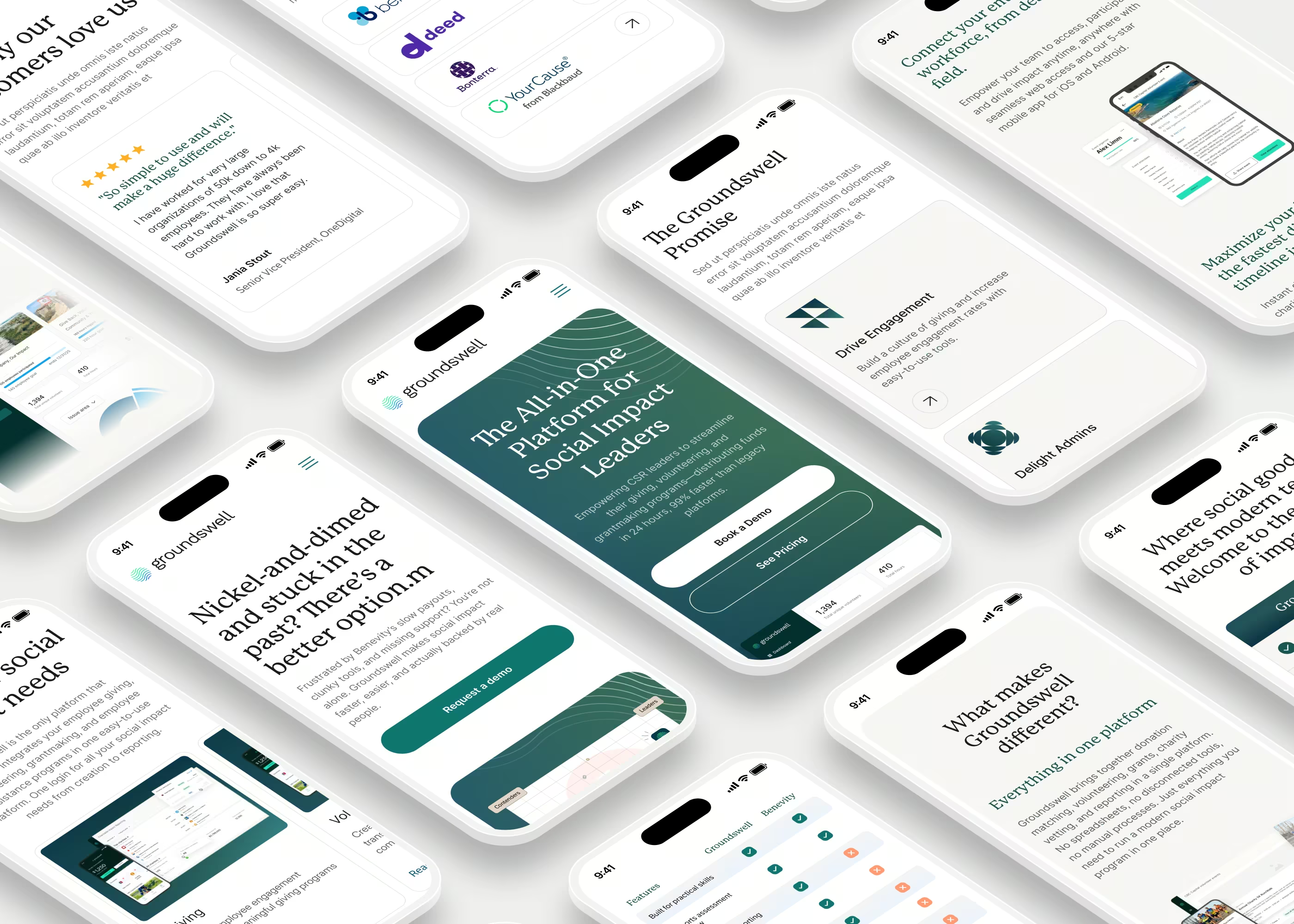
The project grew beyond its original homepage into a wider collection of product, solution, and marketing pages. The company's increasing focus on enterprise customers also called for a more developed website structure.
In a Clutch review, Groundswell's Head of Product Marketing described the goals of the redesign: refreshing the website's branding, introducing reusable templates, and better communicating with enterprise buyers.

The work covered website architecture, navigation, core product and solution pages, messaging, and visual design.
One particularly useful improvement was the introduction of reusable page templates.
Consider what happens when a SaaS marketing team needs to launch a new campaign. The content might be ready, but if every landing page requires a completely new design and development process, publishing becomes slower than it needs to be.
Reusable layouts give the team a starting point. They can adapt an established page structure to new content without repeating every design decision.
For Groundswell, this wasn't just a theoretical benefit.
As the company's needs expanded, the website grew from an initial homepage into more than 120 pages, covering products, solutions, and marketing campaigns. Reusable templates helped support that growth without requiring every new page to be designed from scratch.
For example, the time needed to design and launch a new landing page decreased from approximately two weeks to few days, giving Groundswell's marketing team greater flexibility to respond to new priorities and launch campaigns faster.
Groundswell's Head of Product Marketing also confirmed in their Clutch review that reusable templates significantly reduced the time required to launch new pages and campaigns.
Alongside these improvements, the updated information architecture made it easier for visitors to find relevant content, supporting Groundswell's growing focus on enterprise customers.
Beyond the Website: Social Media and Marketing Design
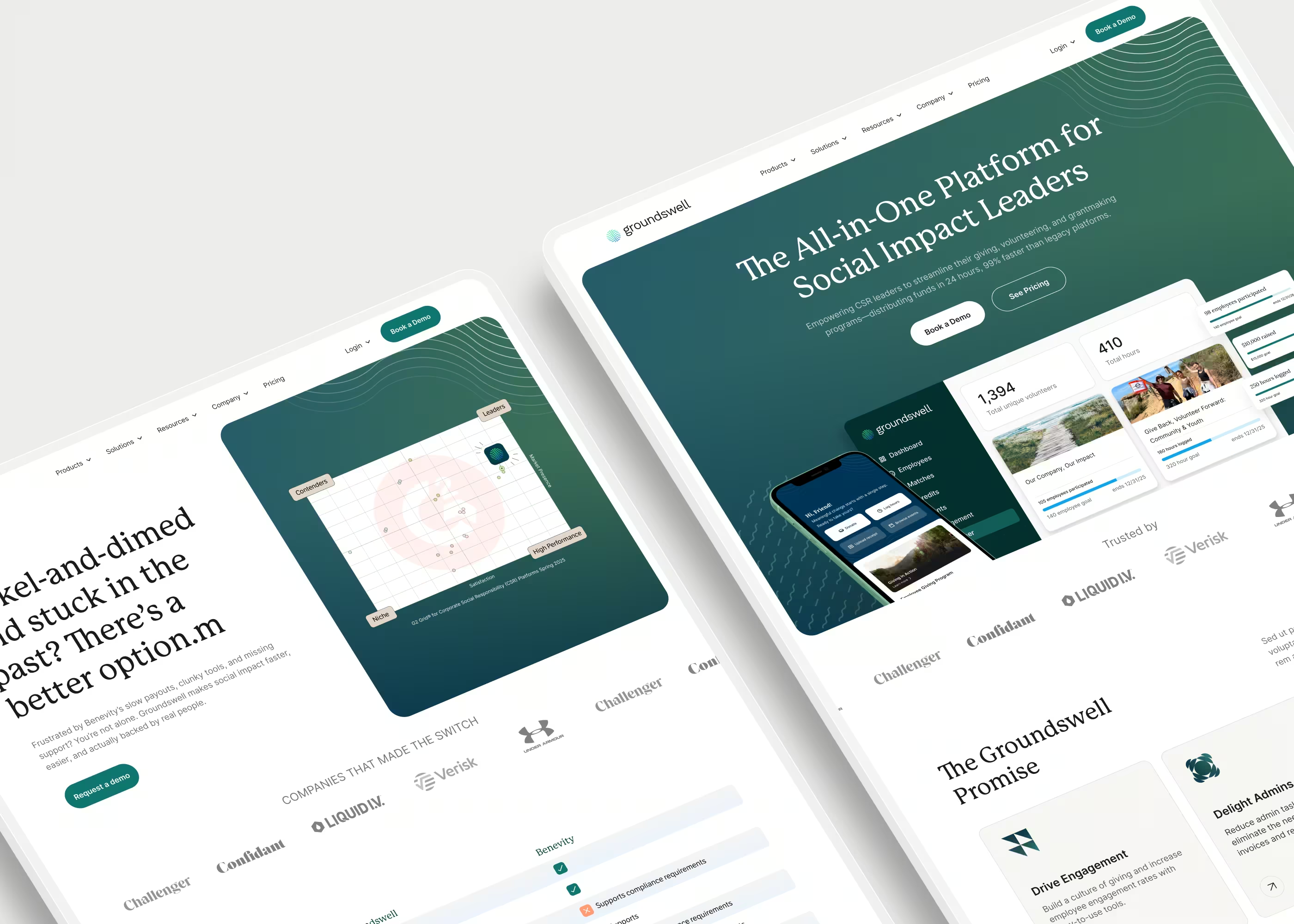
Groundswell's visual identity also needed to work beyond its website. Social media graphics, campaign materials, and other marketing content each have different requirements, but they should still feel connected to the same brand.
The visual direction established for the website provided a starting point for these applications. Colors, typography, and graphic elements could be adapted to different formats without repeating the same layout.
This helped maintain a recognizable identity across Groundswell's digital channels, from product-focused website pages to shorter marketing messages.
From Five Hours a Week to Strategic Design Consulting
My involvement with Groundswell changed as the work expanded.
What started as a small weekly commitment became a closer collaboration with the company's team.
From February 2024 to March 2026, I worked as Lead Web Designer, focusing on website design, landing pages, responsive experiences, and alignment with marketing objectives.
From March to August 2026, I continued as a Design Consultant, advising on website strategy, UX, and funnel optimization.
The change in responsibilities reflected the changing nature of the project.
Early on, much of the work involved establishing and developing the website itself. Later, the discussions increasingly included how visitors interacted with the website, how information was presented, and how the experience could better support marketing goals.
Having worked with Groundswell over an extended period, I already understood much of the context behind those decisions.
I knew the product, the visual direction, and the reasoning behind earlier design choices. That made it easier to evaluate new requests without treating each one as an isolated assignment.
A SaaS website design partnership doesn't need to follow a fixed timeline or involve the same scope from beginning to end. The useful part is having a working relationship that can adapt to what the business needs.
Behind the Designs: Research, Wireframes, and Collaboration
A good-looking page isn't necessarily an effective page. For a growing SaaS company, the design process should help reduce unnecessary revisions, clarify product messaging, and create a website that supports business goals.
Research and stakeholder discussions help identify what potential customers need to understand before taking action. This allows the team to prioritize relevant information rather than making design decisions based on assumptions.
Wireframes help validate the page structure and content hierarchy before moving into detailed visual design. For SaaS founders and marketing teams, this means identifying potential issues earlier, when changes are easier and less time-consuming to make.
Visual design then brings these decisions together through layouts, typography, imagery, and interface elements that reflect the brand and make the product easier to understand.
Regular communication and feedback are equally important. When stakeholders share examples or describe what they want to achieve, understanding the business objective behind their requests helps turn that feedback into practical design solutions.
For Groundswell, this approach supported ongoing website development while keeping the design aligned with changing marketing priorities and enterprise customer expectations.
Groundswell's Head of Product Marketing described this particularly well:
"Mykola Designer was consistently quick to respond to inquiries and seemed to read my mind when I gave him an example of what I was looking for."
That feedback means a lot to me because understanding a client's direction is one of the most important parts of the work. For a company with multiple stakeholders and ongoing marketing priorities, that kind of continuity can make a real difference to the project experience.
What Groundswell's Team Said About the Results
The clearest measure of a website redesign isn't whether the designer likes the finished result. It's whether the website works better for the people using it.
Groundswell's Head of Product Marketing reported that the redesigned website was more polished and better aligned with the company's enterprise positioning.
The team received positive feedback from prospects, customers, and internal stakeholders.
They also highlighted clearer navigation, easier access to relevant content, and the practical value of reusable templates for launching new pages and campaigns.
Beyond the website itself, the client praised the project management experience, including timely delivery, clear communication, responsiveness, and proactive recommendations.
Candice Schmitt, Operations Executive at Groundswell, also shared her experience of working together:
"He produces quality designs on time and is an effective collaborator."
Her feedback highlights an important part of the engagement: the ability to support both new design initiatives and ongoing website needs.
The website needed to help Groundswell present its product more effectively. At the same time, the design process needed to work for the people responsible for reviewing, managing, and launching the work.

What Should SaaS Companies Look for in a Design Partner?
Not every SaaS company needs ongoing design support.
If you're validating an idea and need a simple landing page, a defined project may be enough. But if you're regularly launching features, expanding into new markets, or developing marketing campaigns, it's worth thinking about how design will fit into those activities.
Based on my work with Groundswell and other clients, I'd pay attention to four things when choosing a long-term web designer:
- Understanding your business. Can the designer explain how their decisions support your product, audience, and marketing goals?
- Building with future work in mind. Will new pages fit naturally into the website, or will each request require another custom solution?
- Communicating and collaborating. Can the designer work with different stakeholders, interpret feedback, and recommend improvements when needed?
- Adapting to your needs. Can the engagement change as your priorities shift, without committing you to more design support than you actually need?
A design partner for startups should bring more than a strong portfolio. They should be able to explain their thinking, work within the realities of your business, and help you make informed decisions.
That doesn't mean every engagement needs to last years. It means the collaboration should be useful for the work you need to accomplish.
The Biggest Takeaway From Groundswell
It began with a small weekly design commitment and an early-stage website. Over time, the work expanded into a broader digital experience, with a stronger enterprise focus, clearer navigation, reusable page templates, and strategic design consulting.
For me, the most valuable lesson is that a website should become easier to develop as the business grows, not harder.
That requires making thoughtful decisions about its structure, design, and content from the beginning, then being willing to revisit those decisions when the business changes.
Looking for a Long-Term Design Partner?
Your website should support your business as it grows, not become something you need to rebuild every time your priorities change.
Whether you're launching a new product, preparing for a redesign, or looking for ongoing design support, I can help you identify the right approach for your goals.
Take a look at my selected projects to see how I approach different design challenges and the solutions behind them.
Great design starts with understanding the challenge. Tell me what you're working on, and we'll take it from there.
About the Author:

As a blog author at Mykola Designer, I explain how global teams can build high-converting and trust-building websites. In my articles, I combine strategic UI/UX design with expert marketing and no-code development and provide full-scale landing pages, brand identity systems, and SEO/GEO optimization for startups looking to turn concepts into scalable products.
Let’s connect on LinkedIn or X to build awesome projects together.
Share this article: